
Data centres in Canada are choosing gas for power, while renewables are favoured elsewhere
MEDIA RELEASE
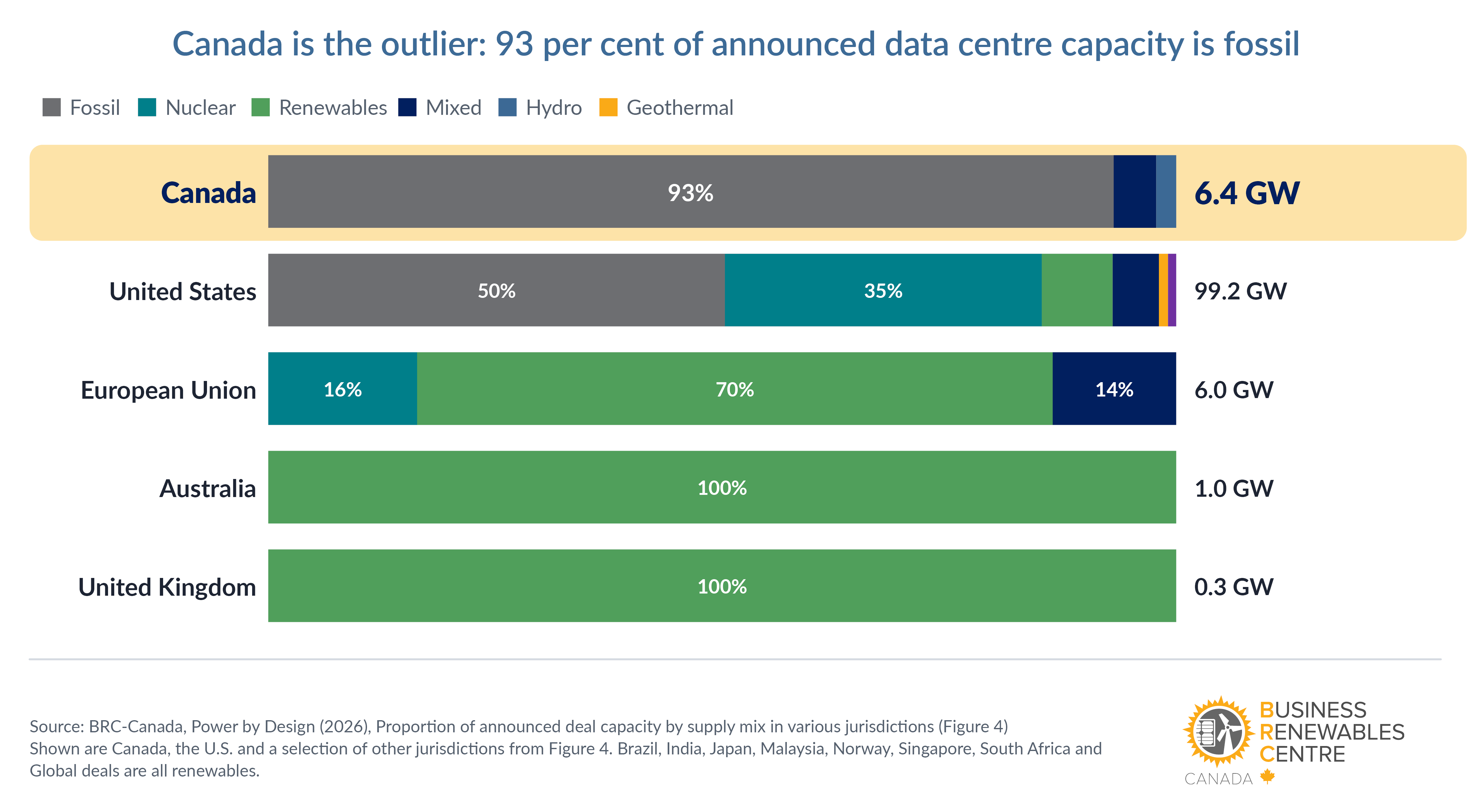
CALGARY – In Canada, almost all the electricity lined up for announced data centres comes from gas, a pattern not seen elsewhere in the world, including the United States. That reliance on gas is a design choice that provincial governments are making, not a necessity, according to a global analysis of data centre power deals across 25 jurisdictions.
Released today by the Business Renewables Centre-Canada (BRC-Canada), the report, Power By Design: How government policy is dictating
the electricity choices of new data centres, draws on 175 announced data centre electricity deals in 25 jurisdictions around the world, tracked through the end of September 2026.
Together, the deals total 126 gigawatts (GW) of new capacity, more than the installed grid capacity of most countries and enough to rank as the 13th largest single grid in the world. Despite this large scale, the deals tracked represent only a small subset of the huge number of data centres that have been proposed globally so actual scale of development could end up being far larger.
The report identified no fossil-fuelled data centre deals before 2024, but since 2025, gas-fired deals more than tripled in a year, from 12.5 GW to 42 GW in 2026, for a total of 55 GW, or 44 per cent of the capacity tracked, which extends back to 2015. These fossil energy deals appear in only two countries: Canada and the United States. If built as announced, these projects would emit at least 160 megatonnes of greenhouse gases a year, more than Ontario's annual emissions and over three times those of Canada's entire electricity sector. Renewable energy remains the most common way data centres are being powered worldwide, featuring in 112 of the 175 deals and found in every jurisdiction studied.
Canada’s 10 announced deals total 6.4 GW, almost all of it gas-fired self supply, despite the country’s abundant clean energy resources. The report finds that, in contrast to the rest of the world, including the United States, Canada has limited the ability of data centre developers to use clean power.
Announced deals have nearly tripled since 2024, from 4 that year to 48 in 2025 and 69 so far in 2026, and the ten largest deals alone account for 72 GW of new demand. Only 50 of the 175 deals are operating today, so most of the capacity is still on paper, and the decisions made now will determine how the build-out is powered.
"Canada’s predominant use of gas generation is an outlier in our review. Around the world, data centres are being powered by renewable energy," said Jorden Dye, Director of BRC-Canada. "Alberta is gaining more data centre proposals than anywhere else in Canada but the current policy direction ensures these projects will be powered by natural gas. Gas isn’t necessarily the only development choice. It’s also a design choice, but it isn’t necessarily the lowest cost or the choice data centre developers would make if governments allowed for more options."
Where policies allow it renewables are often the default: hyperscalers signed 21 renewable energy deals in 2025 and 31 in the first nine months of 2026, and in the European Union, renewable power purchase agreements account for 38 of 42 deals.
The report finds that policy and regulation can shape technology choices as much as, or more than, available resources. The same companies sign very different agreements depending on where they operate. For example, in North America, Amazon is building 12.2 GW of new gas-fired capacity, including a 7.7 GW on-site gas campus in Texas. By contrast, in Australia, it has signed 14 power purchase agreements for renewable energy, and its renewable energy deals total 5.7 GW globally.
The report notes that provinces have significant clean electricity resources and potential for new renewable energy, but that attracting investment will increasingly depend on timely access to electricity, diverse procurement options and proactive infrastructure planning.
"The decisions governments make now will shape our electricity systems and their emissions for decades," said Dye. "Jurisdictions that align energy policy, infrastructure planning and policy design will be best placed to power this new demand with clean, reliable and affordable electricity."
-30-
Visit the Business Renewable Centre - Canada’s website to download a copy of Power By Design: How government policy is dictating the electricity choices of new data centres