
Proposed GHG Protocol changes could double the cost of corporate clean energy in Canada
MEDIA RELEASE
CALGARY – Proposed changes to international corporate emissions guidance, commonly referred to as the GHG Protocol’s Scope 2, followed by companies throughout North America and globally, could more than double the cost of power purchase agreements (PPAs) for Canadian companies and remove most corporate buyers’ ability to act on their electricity emissions, according to a new analysis from Business Renewables Centre-Canada (BRC-Canada). The findings, released today in the report Momentum at Risk: Evaluating proposed amendments to the GHG Protocol’s Scope 2 requirements, come at a critical moment as the GHG Protocol moves toward finalizing its revised guidance, expected in late 2027.
The GHG Protocol, a non-profit partnership between the World Resources Institute (WRI) and the World Business Council for Sustainable Development (WBCSD), has provided guidance to renewable energy buyers on how to quantify and thus reduce their direct greenhouse gas (GHG) emissions. In 2015, the GHG Protocol published guidance on emissions from energy or electricity used but produced offsite, known as Scope 2 emissions. This guidance has underpinned the massive growth in corporate renewable energy purchases worldwide.
Three significant changes are now being proposed to how companies account for their electricity-related emissions:
- The first would require corporations to match their electricity consumption with renewable generation on an hourly basis, replacing the current annual matching approach.
- The second would restrict procurement to the same provincial or territorial market where a company’s electricity use is located.
- The third would require companies to source and verify hourly generation and consumption data, replacing the limited data requirements currently in place.
BRC-Canada’s original analysis, conducted across 19 economic sectors in Alberta, finds that if implemented too quickly, the cost consequences of these changes could be severe and the market infrastructure to support them does not yet exist in Canada.
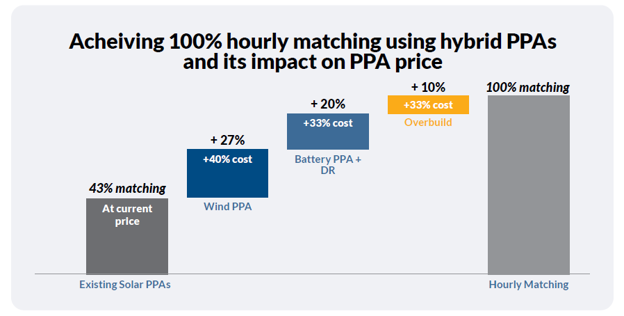
PPA cost increases with hourly matching
BRC-Canada’s analysis modelled the real-world mix of resources buyers would need to reach higher levels of hourly coverage, including solar, wind, battery storage and demand response. Moving from annual matching to 100 per cent hourly matching would raise PPA costs by 98 to 138 per cent across the sectors analyzed. At this scale, the proposal risks stalling the corporate investment that is driving renewable development in the country today.
The geographic matching proposal poses an even greater barrier, as corporate renewable procurement is only feasible in Alberta, with limited options in Nova Scotia and Ontario. BRC-Canada’s 2025 report, From Pledge to Power, found that Canada’s top 100 companies need 7.7 GW of renewable capacity by 2040 to meet Scope 2 targets, but only 19 per cent of that demand is in areas with workable procurement options. Limiting matching to provincial and territorial borders would leave the majority of Canadian companies without a viable way to address their electricity emissions at all. It would also penalize companies for conditions they do not control: nothing in the proposed guidance gives provincial governments an incentive to open their markets to corporate procurement, which is the missing link in the geographic proposal.
"Corporate PPAs are one of the most powerful tools we have for financing new renewable energy projects in Canada," said Jorden Dye, Director of BRC-Canada. "The GHG Protocol’s aim to improve the accuracy of Scope 2 accounting is important, and we support it. But the pace and structure of these proposed changes would make PPAs significantly more expensive and geographically inaccessible for most Canadian buyers. That is not a step forward for decarbonization. It is a barrier to it."
BRC-Canada is not asking the GHG Protocol to lower its ambition. The goal of these revisions is deeper emissions reductions, and BRC-Canada shares it. The concern is with too rapidly applying the same rules uniformly across every jurisdiction. On-the-ground conditions differ from one market to the next, and blanket requirements will hold back the regions where corporate procurement is still taking root. BRC-Canada recommends three changes to the proposed guidance; each built around flexibility and market readiness:
- a phased implementation of hourly matching requirements, ramping to 50 per cent by 2030, 75 per cent by 2035, and 90 per cent by 2040;
- a national-level geographic boundary for deliverable markets, reflecting current procurement realities across Canada; and
- a legacy clause to protect existing contracts and preserve investor confidence in long-term renewable energy deals.
“Twenty-four-seven clean power is no longer a technical problem. It is an economic and regulatory one, and those are problems that industry has solved time and again around the world,” said Dye. “We have real confidence in the buyers and developers we work with to get there over the coming years. What the GHG Protocol needs to recognize is that on-the-ground conditions vary across every region of Canada, let alone around the world. Build in flexibility and a sensible timeline, and you move the market toward full matching. Apply blanket rules to markets that are not ready, and you stall the very investment that reduces emissions in the first place.”
Quick facts
Corporate PPAs have been a significant driver of renewable energy development in Alberta. From January 2019 to March 2026, 3.32 gigawatts (GW) of renewable energy were purchased through PPAs in the province, enabling 4.77 GW of total project capacity. This represents 12,400 gigawatt-hours of energy per year, supporting the creation of 6,200 jobs, $6.4 billion in capital investment, and enough energy to power 1.7 million homes. Currently, 37 solar and 49 wind projects generate over $70 million in annual tax revenues for 26 distinct municipalities across Alberta.
-30-
Visit the Business Renewable Centre - Canada’s website to download a copy of Momentum at Risk: Evaluating proposed amendments to the GHG Protocol’s Scope 2 requirement.